
In the high-stakes world of B2B SaaS, survival often hinges on a pragmatic execution philosophy: “Done is better than perfect.” When you’re sprinting to hit quarterly pipeline targets and capture a moving market, hitting that 80% mark is the new 100%. We ship the campaign, launch the landing page, and optimize the engine while it’s running.
But after more than a decade of building demand generation engines, I’ve realized this agile approach eventually collides with a structural reality of brand reputation: Negative Review Asymmetry. The market’s reaction to your product, whether they champion you on LinkedIn or torch you on G2, isn’t just a reflection of software quality. It is dictated by your product’s Operational Visibility. To build a predictable, scalable pipeline, you cannot rely on a one-size-fits-all playbook. You must first identify which of the two psychological categories your product falls into.
1. The “Silent Infrastructure” Trap
“Silent Infrastructure” includes the backbone of the modern enterprise: cybersecurity networks, cloud hosting servers, payment gateways, or backend ERP systems. Think of companies like CrowdStrike, AWS, or Stripe.
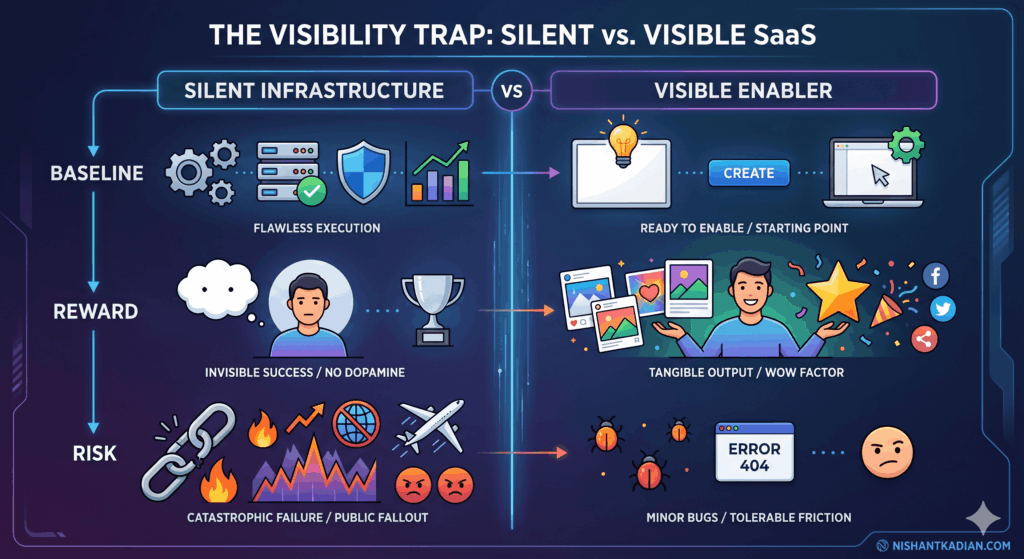
For these products, flawless execution is the absolute baseline expectation. Consider the behavioral psychology at play:
- The Baseline: No IT Director logs onto G2 to leave a 5-star review saying, “My servers didn’t crash today!”
- The Reward: There is no dopamine hit or tangible prize for the user when the product works. Success is simply the invisible absence of failure.
- The Risk: When you ship that “80%-perfect” update and a glitch occurs, the fallout is exponential.
Take the recent CrowdStrike global outage that resulted in crashing of close to 8.5 million systems. When invisible infrastructure breaks, the perceived operational and financial loss is catastrophic. B2B buyers don’t just open a quiet support ticket; they seek punitive justice on public platforms. In this category, the downside is boundless, and organic upside is virtually zero.
2. The “Visible Enabler” Advantage
On the opposite end of the spectrum are “Visible Enablers”. These are tools that create tangible, highly shareable artifacts. Think of Canva, Slack, or generative AI models like Google’s Nano Banana. Remember how Nano Banana pushed Google’s stock prices?
These products operate on a fundamentally different psychological plane:
- The Artifact: The product output is an asset the user is proud of. When a marketer uses an AI tool to generate a stunning campaign visual in seconds, the “value” is an immediate, visible object.
- The Advocacy: Users are naturally inclined to share the output, which inadvertently markets the tool. The product’s core function acts as its own organic referral engine.
- The Buffer: Because the “wow” factor of the final artifact is so high, users are often much more forgiving of minor bugs or friction in the process.
The Demand Gen Playbook: Aligning Strategy to Visibility
Whether you are studying go-to-market strategies or actively managing a multi-million dollar marketing budget, you cannot treat brand reputation as a monolithic metric. Your pipeline architecture must match your visibility profile.
Strategy for Silent Infrastructure: “Manufacture the Invisible”
If your product operates in the background, you will not get organic praise. You have to engineer it.
- Incentivized Proof: You must aggressively “buy” your social proof. Shift resources into high-production case studies and structured, incentivized review campaigns.
- The Trust Loop: Build a Customer Advisory Board (CAB). Because the broader market only hears your name when things break, you need a localized, vocal group of advocates who understand your long-term product roadmap.
- Defensive Positioning: Orient your content strategy and SEO around “Reliability,” “Security,” and “Compliance” rather than flashy innovation.
Strategy for Visible Enablers: “Reduce the Friction”
If your product creates a tangible output, your primary objective is getting the user to their first “shareable moment” as fast as possible.
- Aggressive PLG (Product-Led Growth): Your demand gen motion must focus entirely on “Time to Value.” Every click between a sign-up and a completed artifact is a leak in your conversion funnel.
- Viral Loops: Build sharing mechanisms directly into the user interface. When a user creates something exceptional, make it a one-click process to broadcast it to their network.
- Community-Led Growth: Empower your power users. Distribute templates and highly tactical “how-to” content that allows them to showcase their expertise using your platform.
The Bottom Line
When you understand where your software sits on the visibility spectrum, you stop fighting human psychology. You do not market a backend cybersecurity firm the same way you market a collaborative design tool.
Stop trying to force organic “love” for a product designed to be invisible. Instead, engineer a pipeline that respects how your buyers actually experience value.
Is your product a Silent Infrastructure or a Visible Enabler? Your customer acquisition cost depends on the answer.
